Yew Huoi, How & Associates | Leading Malaysia Law Firm

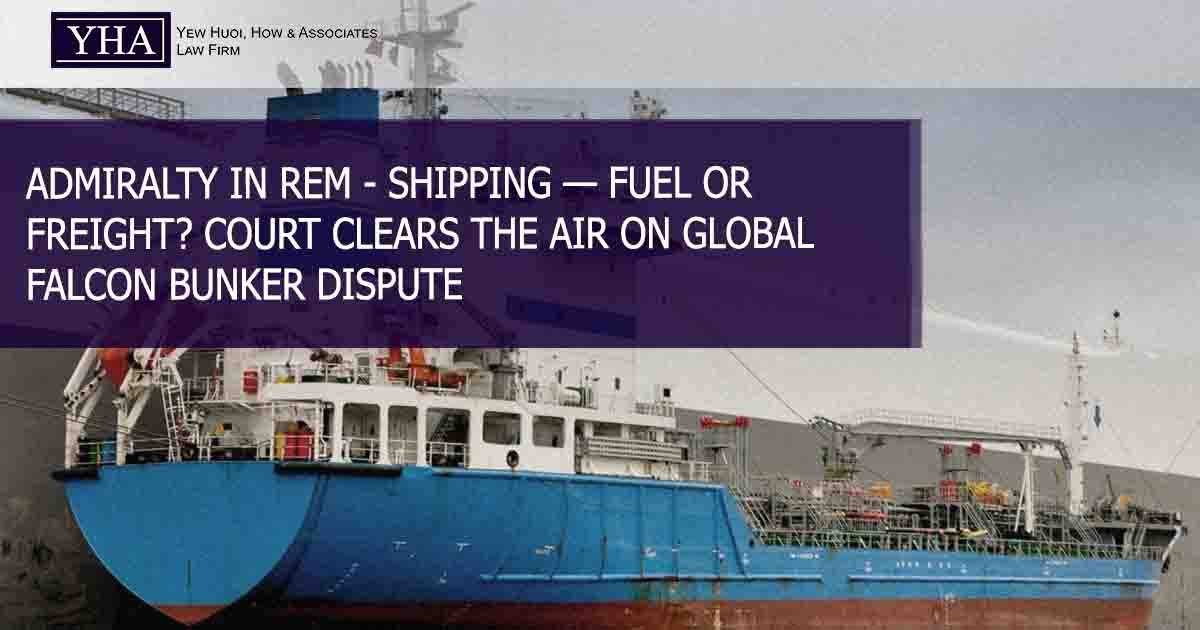
ADMIRALTY IN REM – SHIPPING — FUEL OR FREIGHT? COURT CLEARS THE AIR ON GLOBAL FALCON BUNKER DISPUTE

Summary and Facts

In Global Falcon [2024] MLJU 1378, Meck Petroleum DMCC (“Meck”) supplied high-sulphur fuel oil (HSFO) to the vessel Global Falcon and subsequently claimed USD 1.3 million for unpaid bunkers. Meck initiated admiralty proceedings to arrest the vessel, asserting that the HSFO qualified as goods supplied for the vessel’s “operation or maintenance,” thus entitling them to a maritime lien.

However, the HSFO supplied had a sulphur content of 3.03%, exceeding regulatory limits for operational fuel use, and was loaded into the vessel’s cargo tanks rather than fuel tanks. The Global Falcon lacked scrubbers to process high-sulphur fuel, and the quantity of HSFO supplied was inconsistent with the vessel’s operational needs. Evidence later showed the HSFO was transferred to another vessel, indicating it was intended as cargo rather than operational fuel. Based on these factors, the court questioned if Meck’s claim met the admiralty jurisdiction requirements.

Legal Issues

  1. Qualification as Goods for Operation or Maintenance: Did the HSFO qualify as “goods or materials supplied for the operation or maintenance” of the vessel under Section 20(2)(m) of the UK Senior Courts Act 1981 (“UK SCA 1981”)?
  2. Admiralty Jurisdiction to Arrest the Vessel: Did the court have admiralty jurisdiction to arrest the vessel based on the HSFO supply?

Court Findings

  • The court concluded that the HSFO, with a 3.03% sulphur content exceeding operational fuel limits and loaded into cargo tanks, was not meant for the vessel’s operation or maintenance. This conclusion was supported by:
    • The vessel’s lack of scrubbers to utilize HSFO as fuel.
    • The quantity of HSFO supplied, which far exceeded the vessel’s operational fuel capacity.
    • Evidence showing the HSFO was discharged to another vessel, indicating it served as cargo, not operational fuel.
  • For admiralty jurisdiction to be valid, the claim must meet Section 20(2)(m) or (n) of the UK SCA 1981: “supplied to a ship for her operation or maintenance” or “for the construction or repair of equipment of a ship or in respect of dock charges or dues.”
  • The court held that Meck’s claim did not satisfy Section 20(2)(m) of the UK SCA 1981, as the HSFO was neither used nor intended for the vessel’s operation or maintenance. As a result, the court set aside the Warrant of Arrest, ordered the vessel’s immediate release, and granted the owners liberty to seek damages for wrongful arrest.

Reference Cases

  • Meck Petroleum DMCC v The Owners And/Or Demise Charterers Of The Ship Or Vessel “Global Falcon” Of The Port Of Cook Islands [2024] MLJU 1378
  • UK Senior Court Act 1981 Section 20(2)(m) & (n)
  • The River Rima [1998] 2 Lloyd’s Law Rep 193
  • Port of Geelong Authority v The Ship “Bass Reefer” 109 ALR 505
  • Supreme Court Act 1981

Recent Post

ADMIRALTY IN REM – WRONGFUL ARREST – POSSESORY RIGHT – ARREST GONE WRONG: WHEN A SHIP ARREST BACKFIRES WITH DAMAGES

In Eletson Holdings Inc & Ors v The Vessel “Paros” [2026] 8 MLJ 80, the High Court set aside an arrest after finding that the plaintiffs had no proprietary or possessory right to the vessel at the time of the writ, as the bareboat charter had already been terminated. The Court held that the claim was in substance a corporate control dispute dressed up as an admiralty action, and emphasised that such disputes do not fall within admiralty jurisdiction. Critically, the plaintiffs’ failure to disclose the termination of the charter when obtaining the arrest warrant amounted to a serious breach, leading the Court to find mala fides or gross negligence and order damages for wrongful arrest. The decision reinforces that ship arrest is a powerful remedy that must be exercised with full disclosure and a proper maritime foundation.

Read More »

GUARANTEE – PERSONAL GUARANTEE ≠ PAY ON DEMAND: COURT DRAWS THE LINE BETWEEN SURETYSHIP AND DEMAND GUARANTEES

In CE Energy DMCC v Bashar [2026] Lloyds’s Rep 267, the Commercial Court clarified that not all guarantees labelled “on demand” will be treated as demand guarantees. On a proper construction, the court held that the personal guarantee in question was a contract of suretyship, requiring proof of the principal debtor’s liability rather than automatic payment upon demand. Crucially, the court found that the debtor’s “irrevocable” admissions of debt in a payment agreement created a binding contractual estoppel, which the guarantor could not challenge. The decision also confirms that, where payment is due on a “day certain”, a seller may still claim the price notwithstanding retention of title. The case underscores the importance of precise drafting and the risks of entering into settlement agreements that conclusively fix liability.

Read More »

MARITIME NEGLIGENCE – PLAINTIFF CLAIMED FOR DAMAGES CAUSED DURING ANCHOR DEPLOYMENT OPERATION – CALDERBANK OFFERS

In Tom Eastwind 365 Sdn Bhd v The Owners of the Vessel “Icon Sophia” [2025] 9 MLJ 397, the High Court held that the doctrine of res ipsa loquitur applied in a maritime collision during an anchor deployment operation, allowing an inference of negligence against the tug owner. The Court clarified that the doctrine is not defeated merely because the defendant adduces evidence explaining the accident – such evidence goes to rebutting the inference, not preventing it. While liability was established due to the tug master’s error of judgment in manoeuvring too close to a stationary barge, the plaintiff failed to properly prove its damages and was awarded only RM50,000. Notably, despite succeeding on liability, the plaintiff was ordered to pay costs after rejecting reasonable Calderbank offers, underscoring the risks of pursuing litigation without properly substantiated claims.

Read More »

JURISDICTION – BILLS OF LADING – BREACH OF HIMALAYA CLAUSE – BREACH OF EXCLUSIVE JURISDICTION CLAUSE – ONEROUS OR UNUSUAL TERMS

In Maersk Guinéa-Bissau SARL v Almar-Hum Bubacar Baldé SARL [2026] 1 Lloyd’s Rep 215, the English Commercial Court held that a shipper was liable for breach of an exclusive jurisdiction clause and a Himalaya clause after commencing proceedings in Guinea-Bissau instead of England. The Court confirmed that such clauses are standard and enforceable, and that commencing foreign proceedings in breach of them can give rise to a claim for damages. Notably, the Court also recognised that Himalaya clauses may be used offensively, allowing subcontractors to recover losses caused by wrongful litigation. The foreign judgment was not recognised due to lack of jurisdiction and denial of natural justice.

Read More »

DELIVERY WITHOUT PRESENTATION OF BILL OF LADING – LOI WON’T SAVE YOU: SHIPOWNER LIABLE FOR MISDELIVERY DESPITE INDEMNITY

In United Overseas Bank Ltd v The “Maersk Katalin” [2026] 1 Lloyd’s Rep 18, the Singapore High Court reaffirmed that delivery of cargo without presentation of original bills of lading remains a fundamental breach, even where carried out against letters of indemnity. The Court held that LOIs merely shift commercial risk but do not authorise misdelivery, and rejected arguments of consent, ratification and causation. Significantly, the Court emphasised that the burden lies on the carrier to prove that the loss would have occurred in any event – a burden not easily discharged. The decision underscores the continued strict liability regime in misdelivery cases, particularly where banks as bill holders are involved.

Read More »

CONTRACT LAW – ‘UK COURTS’ MEANS ENGLAND: COURT UPHOLDS JURISDICTION DESPITE VAGUE CLAUSE

In SMT Global Logistics Ltd v Georgian Airlines LLC [2025] Lloyd’s Rep. Plus 89, the Commercial Court held that a clause referring disputes to “the court in accordance with current legislation of the United Kingdom” was a valid jurisdiction clause in favour of the High Court of England and Wales. The Court also confirmed that the Montreal Convention does not apply to pure contractual claims for non-performance, such as repayment and loss of profits. Emphasising a broad and commercially sensible interpretation, the Court enforced the parties’ choice of forum and refused to stay proceedings, reaffirming that jurisdiction clauses will be upheld unless there are overwhelming reasons to depart.

Read More »
en_USEN