
LEGAL UPDATES – CONTRACT – BREACH – LEGITIMATE EXPECTATION – HOPE IS NOT A CONTRACT: COURT REJECTS CLAIM BASED ON LEGITIMATE EXPECTATION

Can a party recover millions based on an expectation that a business relationship would continue? In Shapers International Sdn Bhd & Ors v Halal Industry Development Corp Sdn Bhd & Anor [2026] 10 MLJ 58, the High Court held that it cannot. While the plaintiffs successfully recovered the unpaid balance confirmed by a binding independent audit, the Court rejected their RM32 million claim for loss of future opportunities, holding that legitimate expectation cannot override clear contractual terms. Where a contract expressly requires fresh negotiations and written agreement for future projects, commercial expectations alone do not create enforceable legal rights.
REGULATIONS – GENERAL AGREEMENT ON TARIFFS AND TRADE (GATT 1947 )
On 3.4.2025, the United States imposed a 24% tariff on Malaysian exports, triggering concerns over its legality under international trade law. The measure appears to breach core WTO obligations, including Most-Favoured Nation treatment and tariff bindings. Malaysia has strong grounds to challenge the tariff through WTO dispute settlement, though enforcement could be delayed due to the Appellate Body impasse. In the meantime, Malaysia is pursuing diplomatic avenues, highlighting the importance of rules-based trade amid rising global protectionism.
TRADEMARK – BUSINESS SABOTAGE AND TRADEMARK MISUSE
Businesses must be vigilant in protecting their contractual rights, brand identity, and operational control. In this case, unauthorized control over online booking platforms, misleading alterations to the hotel’s digital presence, and continued use of trademarks post-termination led to significant legal consequences. This ruling highlights the importance of clear agreements, strict compliance with contractual obligations, and proactive enforcement of intellectual property rights.
LEGAL UPDATES – INTERNATIONAL TRADE – LEGALITY OF THE 24% U.S. TARIFF ON MALAYSIAN EXPORTS UNDER INTERNATIONAL TRADE LAW
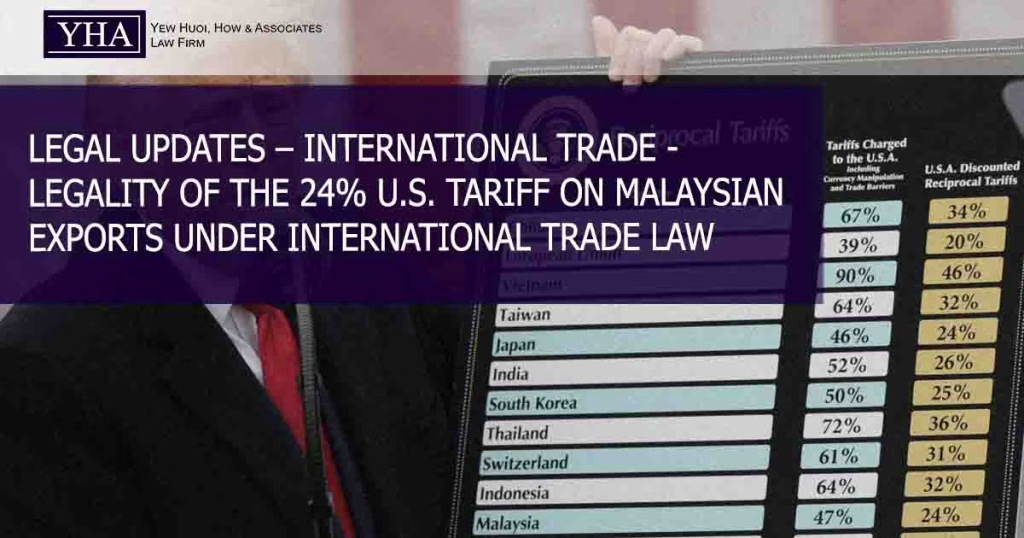
1. Background: In 3.4.2025, the United States imposed a sweeping 24% ad valorem tariff on virtually all Malaysian exports to the U.S., on top of a new 10% universal baseline import duty. The measure was part of a broader “reciprocal tariff” policy by the U.S. government aimed at countries with significant trade surpluses and alleged […]
REGULATIONS – GENERAL AGREEMENT ON TARIFFS AND TRADE (GATT 1947 ) – ARTICLE I
This legal update explores key provisions of the General Agreement on Tariffs and Trade (GATT 1947), focusing on Article I (Most-Favoured-Nation Treatment), Article II (Schedules of Concessions), Article XX (General Exceptions), and Article XXI (Security Exceptions). Article I mandates that any trade advantage granted by one contracting party to another must be extended unconditionally to all other parties. Article II ensures that imported goods from contracting parties receive treatment no less favourable than that outlined in agreed schedules, while also regulating permissible taxes and charges. Articles XX and XXI provide exceptions for measures necessary to protect public morals, health, security interests, and compliance with domestic laws. The provisions reflect the foundational principles of non-discrimination, transparency, and fair trade, while allowing for limited, well-defined exceptions. This summary is intended to provide a concise reference for businesses and legal practitioners involved in international trade law.
USE OF STRATA PROPERTY FOR SHORT-TERM RENTAL PURPOSE

Use of strata property for short term rental purpose.
 EN
EN  ZH
ZH  MY
MY