
COMMERCIAL CONTRACT – FORCE MAJEURE OR JUST EXCUSES? LESSONS FROM LITASCO V DER MOND OIL [2024] 2 LLOYD’S REP 593
The recent decision in Litasco SA v Der Mond Oil and Gas Africa SA [2024] 2 Lloyd’s Rep 593 highlights the strict thresholds required to invoke defences such as force majeure and trade sanctions in commercial disputes. The English Commercial Court dismissed claims of misrepresentation and found that banking restrictions and sanctions did not excuse payment obligations under the crude oil contract. This judgment reinforces the importance of precise contractual drafting and credible evidence in defending against payment claims, serving as a cautionary tale for businesses navigating international trade and legal obligations.
CHARTERPARTY AGREEMENTS – CHARTERER’S GUIDE TO FOULING CLAUSES
In maritime charterparty agreements, fouling clauses outline who is responsible for the costs and time associated with hull cleaning when marine organisms accumulate due to specific operating conditions. These clauses are crucial for clarifying liabilities, particularly when charterers operate in warm, bio-rich waters or leave vessels idle, as fouling can significantly impact performance and fuel efficiency. Understanding the scope of a fouling clause helps charterers navigate potential costs and ensure clear terms for post-redelivery responsibilities, as highlighted in cases like The “Globe Danae” [2024] 1 Lloyd’s Rep. 309.
BREACH OF CONTRACT – DAMAGES – FORESEEABILITY AND FAIRNESS IN FREIGHT LIABILITY CLAIMS
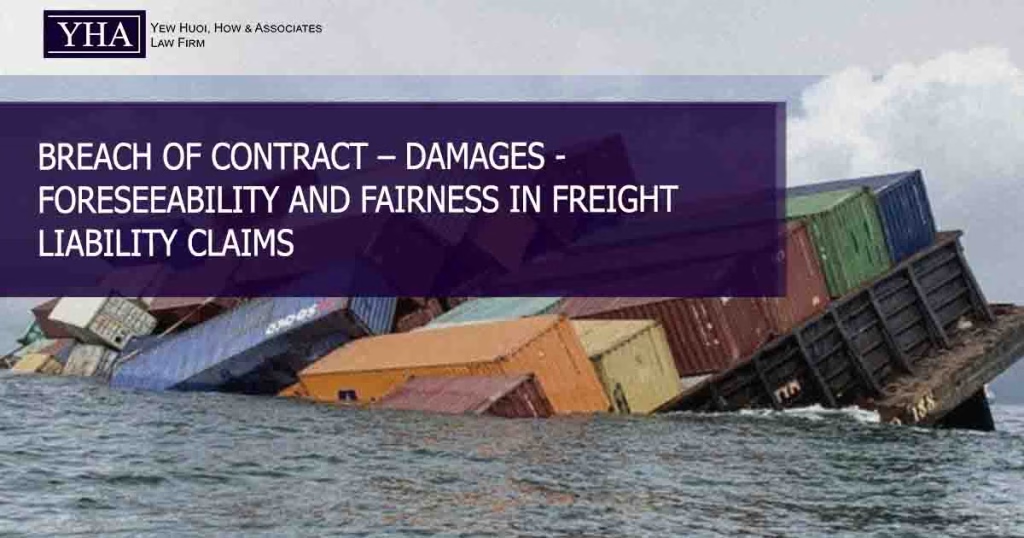
In JSD Corporation v Tri-Line Express [2024] 1 Lloyd’s Rep. 285, the court set a clear precedent on damages for property claims, ruling that only foreseeable and proportionate losses are recoverable. Applying principles akin to Hadley v Baxendale, the court allowed for repair costs if intent to remedy was evident but rejected double recovery, underscoring that damages must reflect actual loss without overcompensation. This decision serves as a guide for Malaysian courts, emphasizing fair and balanced recovery in line with foreseeable damages.
ADMIRALTY IN REM – SHIPPING — FUEL OR FREIGHT? COURT CLEARS THE AIR ON GLOBAL FALCON BUNKER DISPUTE
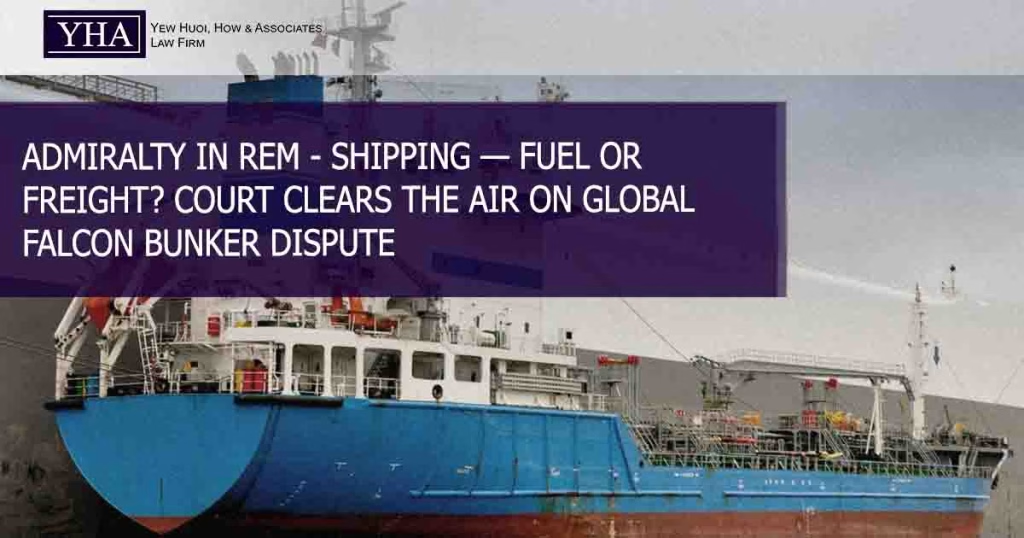
In a decisive ruling on the Global Falcon bunker dispute, the court dismissed Meck Petroleum’s admiralty claim for unpaid high-sulphur fuel, finding that the fuel was supplied not for operational purposes but as cargo. With the vessel lacking necessary equipment to use high-sulphur fuel and evidence pointing to its transfer to another vessel, the court determined that Meck’s claim fell outside admiralty jurisdiction, leading to the release of the vessel and potential damages for wrongful arrest.
COLLISION COURSE – COURT WEIGHS ANCHOR DRAGGING AND LIABILITY AT SEA
In a collision that underscores the high stakes of maritime vigilance, the court ruled that Belpareil bore the brunt of the blame for failing to control its dragging anchor and delaying critical warnings. Yet, Kiran Australia wasn’t off the hook entirely—apportioned 30% fault for its limited evasive action, the case serves as a stark reminder: in maritime law, all vessels share responsibility in averting disaster, even when one party’s errors loom large.
GENERAL AVERAGE – PIRATE RANSOM DISPUTE: SUPREME COURT RULES CARGO OWNERS LIABLE IN THE POLAR CASE
In the landmark case Herculito Maritime Ltd v Gunvor International BV (The Polar) [2024] 1 Lloyd’s Rep. 85, the English Supreme Court upheld the shipowner’s right to recover a USD 7.7 million ransom paid to Somali pirates under general average. The Court ruled that cargo interests, despite their arguments regarding charterparty terms and insurance obligations, were liable to contribute to the ransom payment. This decision reinforces the importance of clear contractual provisions when seeking to limit or exclude liability in maritime contracts particularly matter relating to general average.
BROAD INTERPRETATION OF ‘SUBSEQUENT MODIFICATION’ APPLIES YORK-ANTWERP RULES 2016 GOVERNING GENERAL AVERAGE IN STAR AXE I LLC V ROYAL & SUN ALLIANCE
In Star Axe I LLC v Royal and Sun Alliance Luxembourg SA [2024] 1 Lloyd’s Rep 342, the court determined that the phrase “any subsequent modification” in the bills of lading extended to the York-Antwerp Rules 2016, not just amendments to the 1994 version. This broad interpretation significantly impacted the general average adjustments, applying the more modern rules outlined in the YAR 2016. The decision emphasize the importance of clear contract language when referring to evolving sets of industry rules, as it directly influences the liabilities and cost-sharing in maritime incidents.
COURT UPHOLDS RECAP EMAIL AS BINDING CONTRACT IN MARITIME DISPUTE: PORALU MARINE V MV DIJKSGRACHT
In the recent case of Poralu Marine Australia Pty Ltd v MV Dijksgracht [2023], the Federal Court of Australia Full Court (FCAFC) ruled that a second recap email, summarizing key terms from negotiations, constituted the binding contract of carriage rather than the subsequent booking note. The court found that the recap email reflected the final agreement between the parties, while the booking note attempted to introduce new terms, including liability limits, which were not mutually agreed upon. This decision emphasizes the importance of recap emails in maritime contracts and reinforces the application of the Hague-Visby Rules in such cases.
CARGO CONUNDRUM: OWNERSHIP, LIABILITY, AND INHERENT VICE IN THE JB COCOA V MAERSK LINE CASE
This case examines the liability of Maersk Line for damages to a shipment of cocoa beans, focusing on whether JB Cocoa had standing as the owner, and whether Maersk fulfilled its obligations under the bill of lading and the Hague Rules. The court also considered the application of the inherent vice defense in relation to the damaged cargo.
ONE-YEAR TIME BAR FOR MISDELIVERY CLAIMS REINFORCED BY COURT OF APPEAL IN FIMBANK PLC V KCH SHIPPING CO LTD (THE GIANT ACE) [2024]
In the recent decision of the English Court of Appeal in FIMBank plc v KCH Shipping Co Ltd (The Giant Ace) [2024], the court upheld that the one-year time bar under Article III Rule 6 of the Hague-Visby Rules, which are applicable in Malaysia under the Carriage of Goods by Sea Act 1950 (COGSA), applies to all liabilities, including claims for misdelivery of cargo, even when the misdelivery occurs after discharge. The court emphasized the broad application of the phrase “all liability whatsoever in respect of the goods”, confirming that the amended rule was designed to extend the time limit to cover such claims. This ruling underscores the need for timely legal action within the one-year period, reinforcing legal protection for carriers in both the UK and Malaysia.
 MY
MY  EN
EN  ZH
ZH