
MONEYLENDERS ACT 1951- UNJUST ENRICHMENT OR ILLEGAL LOAN? COURT WEIGHS RESTITUTION AGAINST THE MONEYLENDERS ACT
In Golden Wheel Credit Sdn Bhd v Dato’ Siah Teong Din [2021] 12 MLJ, the Court considered whether a licensed moneylender, whose loan agreements were void for non-compliance with the Moneylenders Act 1951, could nevertheless pursue restitutionary remedies. The plaintiff, having advanced RM3.5 million which was channelled to the defendant’s company, sought recovery on grounds of money had and received and unjust enrichment under the Contracts Act 1950. The defendant applied to strike out the claim, arguing that it was merely an indirect attempt to enforce an illegal loan. The case illustrates the delicate balance between statutory illegality under the Moneylenders Act and the equitable principles underpinning restitution.
TRADEMARK – BUSINESS SABOTAGE AND TRADEMARK MISUSE
Businesses must be vigilant in protecting their contractual rights, brand identity, and operational control. In this case, unauthorized control over online booking platforms, misleading alterations to the hotel’s digital presence, and continued use of trademarks post-termination led to significant legal consequences. This ruling highlights the importance of clear agreements, strict compliance with contractual obligations, and proactive enforcement of intellectual property rights.
LEGAL UPDATES – INTERNATIONAL TRADE – LEGALITY OF THE 24% U.S. TARIFF ON MALAYSIAN EXPORTS UNDER INTERNATIONAL TRADE LAW
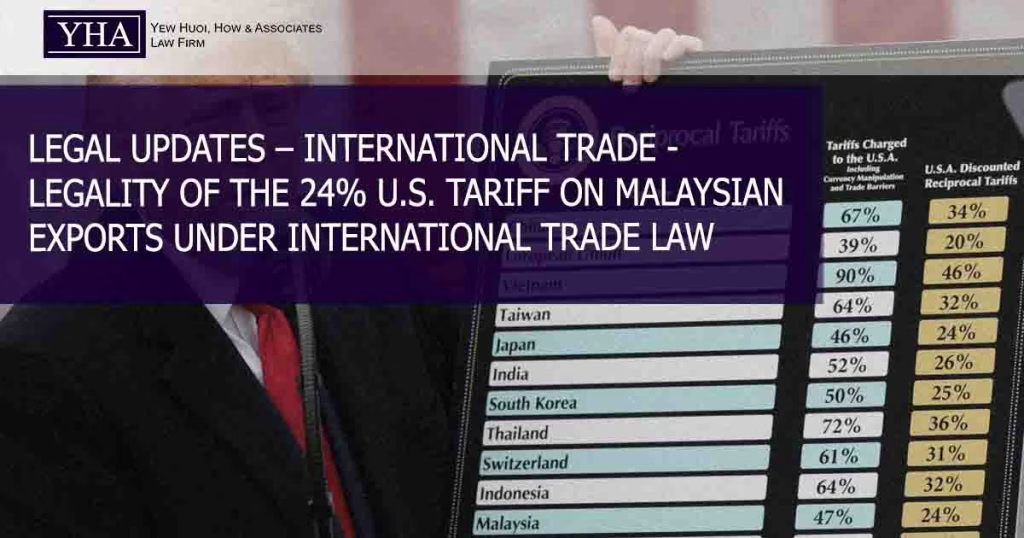
1. Background: In 3.4.2025, the United States imposed a sweeping 24% ad valorem tariff on virtually all Malaysian exports to the U.S., on top of a new 10% universal baseline import duty. The measure was part of a broader “reciprocal tariff” policy by the U.S. government aimed at countries with significant trade surpluses and alleged […]
REGULATIONS – GENERAL AGREEMENT ON TARIFFS AND TRADE (GATT 1947 ) – ARTICLE I
This legal update explores key provisions of the General Agreement on Tariffs and Trade (GATT 1947), focusing on Article I (Most-Favoured-Nation Treatment), Article II (Schedules of Concessions), Article XX (General Exceptions), and Article XXI (Security Exceptions). Article I mandates that any trade advantage granted by one contracting party to another must be extended unconditionally to all other parties. Article II ensures that imported goods from contracting parties receive treatment no less favourable than that outlined in agreed schedules, while also regulating permissible taxes and charges. Articles XX and XXI provide exceptions for measures necessary to protect public morals, health, security interests, and compliance with domestic laws. The provisions reflect the foundational principles of non-discrimination, transparency, and fair trade, while allowing for limited, well-defined exceptions. This summary is intended to provide a concise reference for businesses and legal practitioners involved in international trade law.
TRADEMARK – BUSINESS SABOTAGE AND TRADEMARK MISUSE

Businesses must be vigilant in protecting their contractual rights, brand identity, and operational control. In this case, unauthorized control over online booking platforms, misleading alterations to the hotel’s digital presence, and continued use of trademarks post-termination led to significant legal consequences. This ruling highlights the importance of clear agreements, strict compliance with contractual obligations, and proactive enforcement of intellectual property rights.
CONTRACTS – CONTRACT FOR THE SALE OF GOODS FOB – REMOTENESS OF DAMAGES IN BACK-TO-BACK CONTRACTS – COURT DEFINES LIMITS ON LIABILITY

In a complex dispute involving back-to-back contracts, the court clarified the boundaries for assessing damages, emphasizing that a chain of contracts does not automatically ensure liability passes through. Although substantial losses resulted from delays and disruption, the court highlighted the importance of the remoteness of damages, noting that each contract’s unique terms ultimately limited liability. This decision emphasise the need for parties in chain contracts to carefully define indemnity and liability provisions, as damages are assessed based on foreseeability rather than simply the structure of linked agreements.
COURT UPHOLDS RECAP EMAIL AS BINDING CONTRACT IN MARITIME DISPUTE: PORALU MARINE V MV DIJKSGRACHT
In the recent case of Poralu Marine Australia Pty Ltd v MV Dijksgracht [2023], the Federal Court of Australia Full Court (FCAFC) ruled that a second recap email, summarizing key terms from negotiations, constituted the binding contract of carriage rather than the subsequent booking note. The court found that the recap email reflected the final agreement between the parties, while the booking note attempted to introduce new terms, including liability limits, which were not mutually agreed upon. This decision emphasizes the importance of recap emails in maritime contracts and reinforces the application of the Hague-Visby Rules in such cases.
CONTRACT – CHALLENGING RESTRICTIVE COVENANTS: CAN A SOLICITOR BE BARRED FROM PRACTICING?
This update examines whether a restrictive clause preventing an advocate from practicing law after termination is enforceable. By interpreting Section 28 of the Contracts Act 1950, it highlights that agreements restricting lawful professional practice are generally void, emphasizing the protection of an individual’s right to practice their profession.
CONTRACT LAW – CONTRACTUAL INTERPRETATION REMEDIES UNVEILED: DECIPHERING CONTRACTUAL CLAUSES AND LEGAL BALANCE
This legal updates explore the principles governing the interpretation of agreements, emphasizing the importance of clarity and unambiguity in contractual terms. It delves into a key issue involving restrictions on remedies for breach of contract, shedding light on the court’s commitment to upholding plain meanings. The illustrative scenario involving shareholders X and Y dissects a pertinent clause, showcasing the delicate balance between restricting remedies and ensuring fairness in legal proceedings.
COMPANIES ACT 2016 – DIRECTOR’S RIGHT TO INSPECT RECORDS AND DOCUMENTS OF A COMPANY
A, a director and shareholder of the company, was denied access to inspect the company’s records. Although not involved in daily operations, A wants to determine the value of his shares for a separate lawsuit.
Can he file an application for inspection and appoint lawyers and auditors to do it on his behalf?
 MY
MY  EN
EN  ZH
ZH