
INCOMPETENT MASTER – TEST FOR UNSEAWORTHINESS – GENERAL AVERAGE CONTRIBUTIONS – CARRIER’S DUTIES
In Unity Ship Group SA v Euroins Insurance JSC (The “Happy Aras”) [2026] 1 Lloyd’s Rep 151, the Admiralty Court dismissed a shipowner’s claim for general average contribution after finding that the vessel was unseaworthy due to the incompetence of its master. The Court held that the master’s numerous failures – including deviating from the passage plan, ignoring warnings, and making false log entries – amounted to a complete dereliction of duty. As the loss arose from the carrier’s own actionable fault and the owners failed to prove due diligence under the Hague Rules, the claim for contribution was defeated entirely.
DELIVERY WITHOUT PRESENTATION OF BILL OF LADING – LOI WON’T SAVE YOU: SHIPOWNER LIABLE FOR MISDELIVERY DESPITE INDEMNITY
In United Overseas Bank Ltd v The “Maersk Katalin” [2026] 1 Lloyd’s Rep 18, the Singapore High Court reaffirmed that delivery of cargo without presentation of original bills of lading remains a fundamental breach, even where carried out against letters of indemnity. The Court held that LOIs merely shift commercial risk but do not authorise misdelivery, and rejected arguments of consent, ratification and causation. Significantly, the Court emphasised that the burden lies on the carrier to prove that the loss would have occurred in any event – a burden not easily discharged. The decision underscores the continued strict liability regime in misdelivery cases, particularly where banks as bill holders are involved.
MARITIME LAW – CLAUSES 28 AND 29 BARECON 2001 – OWNERS CAN’T PICK ANY PORT: COURT LIMITS ‘CONVENIENCE’ IN VESSEL REPOSSESSION CLAUSE
In Songa Product and Chemical Tankers III AS v Kairos Shipping II LLC [2026] 1 Lloyd’s Rep 100, the Court of Appeal held that a clause allowing owners to repossess a vessel at a location “convenient to them” does not entitle them to demand redelivery at any distant port of their choosing. The Court emphasised that repossession must occur as soon as reasonably practicable, and where the vessel is already at a safe and accessible port, owners cannot require charterers to incur the cost and risk of sailing it across the world. The decision clarifies that charterers, as gratuitous bailees post-termination, are only obliged to preserve the vessel – not to undertake burdensome repositioning for the owners’ convenience.
MARINE INSURANCE – FRAUD DOESN’T DEFEAT COVER: COURT UPHOLDS MORTGAGEE’S CLAIM UNDER MII POLICY OF MORTGAGEE’S CLAIM
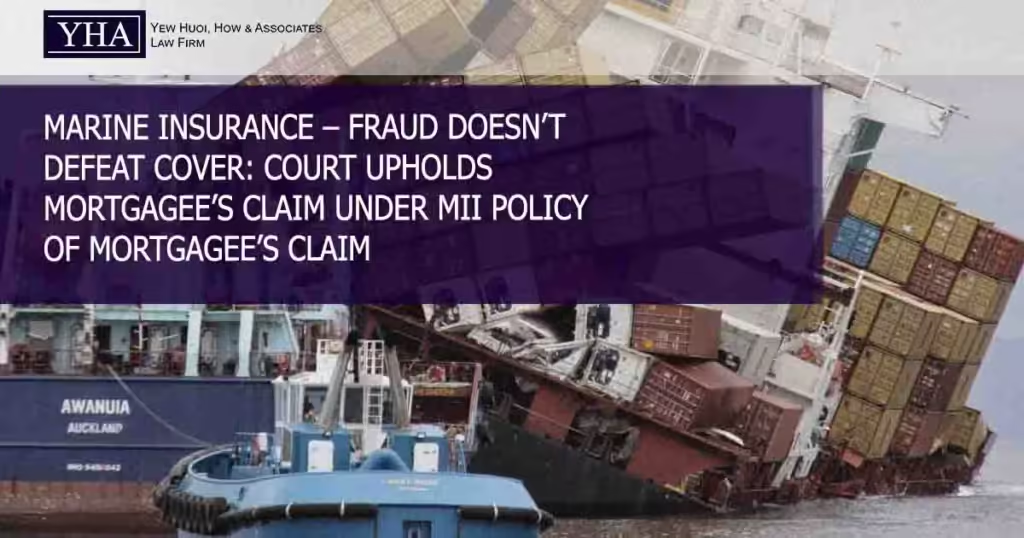
In Oceanus Capital Sarl v Lloyd’s Insurance Co SA (The “Vyssos”) [2026] 1 Lloyd’s Rep 79, the Commercial Court held that a mortgagee was entitled to recover under a Mortgagee’s Interest Insurance (MII) policy despite a forged war risks cover note and a breach of trading warranties by the shipowner. The Court found that the proximate cause of loss was the mine strike, not the forged insurance, and that the mortgagee was not “privy” to the breach, as its consent had been induced by fraud. The decision reinforces that MII policies are designed to protect lenders from owner misconduct and non-recovery under primary insurance, and that fraud will not defeat cover where the mortgagee acted reasonably.
CONTRACT (BILL OF LADING) – NO DUTY TO DETECT FRAUD: COURT CLEARS MAERSK OF LIABILITY FOR FALSE CONTAINER WEIGHTS
In Stournaras Stylianos Monoprosopi EPE v Maersk A/S [2025] 2 Lloyd’s Rep 323, the English Commercial Court held that carriers are not liable for fraudulent misdeclarations by shippers where bills of lading are issued for sealed containers. The Court ruled that Maersk had no duty to verify or cross-check declared weights against Verified Gross Mass (VGM) data under the SOLAS Convention, as its obligation under the Hague Rules extended only to the apparent external condition of cargo. However, the judgment signals that a limited duty of care could arise in future where a carrier is put on notice of fraud. For now, carriers may rely on shipper declarations, but consignees must exercise commercial vigilance and due diligence when relying on bills for payment.
LEGAL UPDATES – ADMIRALTY JURISDICTION BROADENS: TRUST AND CONVERSION CLAIMS RECOGNISED IN THE MERLION APPLICATION
In Burrows v The Ship “Merlion” [2025] 2 Lloyd’s Rep 281, the Federal Court of Australia confirmed that trust, equitable ownership, conversion, and detinue claims can fall within Admiralty jurisdiction where they relate to a ship’s ownership or possession. However, the Court struck out the Australian Consumer Law claim, finding it a personal cause of action that could not ground an in rem proceeding. The judgment is persuasive for Malaysia, where under section 24(b) of the Courts of Judicature Act 1964 and Order 70 of the Rules of Court 2012, Malaysian courts are also likely to recognise trust-based or possessory interests as proprietary maritime claims, while maintaining the need to file personal contractual claims separately.
ADMIRALTY – SINGAPORE HIGH COURT CLARIFIES RIGHTS OF SUIT UNDER BILLS OF LADING ACT AND WRONGFUL ARREST THRESHOLD IN THE JEIL CRYSTAL
In Owners of the Cargo Lately Laden on Board “Jeil Crystal” v Owners of the Vessel “Jeil Crystal” [2025] 2 Lloyd’s Rep 299, the Singapore High Court clarified the operation of the Bills of Lading Act 1992 and the threshold for wrongful arrest. The Court held that Banque Cantonale de Genève (BCGE) ceased to be the lawful holder of the bills of lading once it endorsed and delivered them to its customer, GP Global. Having divested itself of all rights, BCGE had no standing to sue for wrongful switch bills or misdelivery when it arrested the vessel months later. The arrest was found wrongful, as BCGE acted with gross negligence by failing to verify that it possessed the original bills before seeking arrest. This decision reinforces the strict requirement of poss…
ADMIRALTY – LIMITATION OF LIABILITY – REPAIRS VS CARGO REMOVAL: SUPREME COURT DRAWS THE LINE ON LIMITATION1976, ARTICLE 2
In MSC Mediterranean Shipping Co SA v Conti 11 Container Schiffahrts-GmbH & Co KG (The “MSC Flaminia”) [2025] 2 Lloyd’s Rep 150, the UK Supreme Court clarified the scope of the 1976 Limitation Convention. The Court held that charterers may limit liability for claims brought directly by owners, rejecting the Court of Appeal’s restrictive “owner’s original loss” rule. However, it reaffirmed that claims for loss of or damage to the vessel itself and consequential losses remain non-limitable. Importantly, the Court drew a distinction between repair costs (not limitable) and cargo-related costs (potentially limitable): while payments to authorities, removal of fire-fighting water, and waste disposal were treated as repair costs, the discharging and decontamination of cargo fell within Article 2.1(e) as limitable claims. The ruling underscores the need for careful characterisation of claims when invoking limitation rights.
MARITIME LAW – PORT CHARGES – BERTH AND BILL – COURT ANCHORS LIABILITY FOR PORT DUES ON IDLE VESSEL
In Marina Developments Ltd v Owner(S) Of “Sy Explorer” [2025] 1 Lloyd’s Rep 428, the court upheld the Port Authority’s statutory right to recover outstanding berthing charges, despite claims of abandonment by the vessel’s owners. The judgment reinforces that unless formal legal abandonment procedures are undertaken, port dues will continue to accrue. This decision affirms that even stationary vessels carry financial obligations, and port authorities can enforce recovery under maritime law protocols.
MARITIME LAW – BILLS OF LADING – NO BILL, NO CARGO – SHIPOWNERS HELD LIABLE FOR MISDELIVERY WITHOUT ORIGINAL BL
In the pivotal case of The Doric Valour [2025] 1 Lloyd’s Rep 401, the Court of Appeal affirmed the stringent maritime principle that cargo cannot lawfully be released without the surrender of original bills of lading. Rejecting shipowners’ reliance on indemnities to justify cargo delivery without original documents, the Court emphasized the sanctity of the bill of lading as the cornerstone of secure international trade. This decision serves as a robust reminder for maritime operators that compliance with established shipping documentation procedures is mandatory to avoid serious liabilities.
 MY
MY  EN
EN  ZH
ZH