
GAMBLING DEBT – NOT JUST A LOAN, STILL A GAMBLE – FEDERAL COURT DEALS FINAL BLOW TO CASINO CREDIT RECOVERY

In Dato’ Ting Ching Lee v Ting Siu Hua [2025] 2 MLJ 295, the Federal Court delivered a decisive ruling on the enforceability of gambling-related debts disguised as credit facilities. The Court held that credit lines granted for the sole purpose of purchasing casino chips constituted a composite gambling contract, not a genuine loan – and are therefore unenforceable under Malaysian law.
In overruling Wynn Resorts (Macau) SA v Poh Yang Hong, the Court reinforced that no matter how cleverly disguised, claims tied to gambling are void and against public policy. The decision serves as a stark reminder: Malaysian courts will not act as debt collectors for foreign casinos.
REGULATIONS – GENERAL AGREEMENT ON TARIFFS AND TRADE (GATT 1947 )
On 3.4.2025, the United States imposed a 24% tariff on Malaysian exports, triggering concerns over its legality under international trade law. The measure appears to breach core WTO obligations, including Most-Favoured Nation treatment and tariff bindings. Malaysia has strong grounds to challenge the tariff through WTO dispute settlement, though enforcement could be delayed due to the Appellate Body impasse. In the meantime, Malaysia is pursuing diplomatic avenues, highlighting the importance of rules-based trade amid rising global protectionism.
MEDICAL NEGLIGENCE & VICARIOUS LIABILITY – VACUUM EXTRACTION GONE WRONG: COURT HOLDS HOSPITAL LIABLE FOR CHILDBIRTH INJURY

The Court of Appeal decisively overturned the High Court’s findings, emphasizing the critical importance of accurate medical documentation and proper patient counseling. The hospital was held vicariously liable for its medical officer’s negligence, highlighting a clear judicial stance on protecting patient rights during childbirth procedures.
ROAD ACCIDENT – MOTOR INSURANCE CLAIM – FEDERAL COURT TO INSURERS – NO MORE DELAYING THIRD-PARTY PAYOUTS!
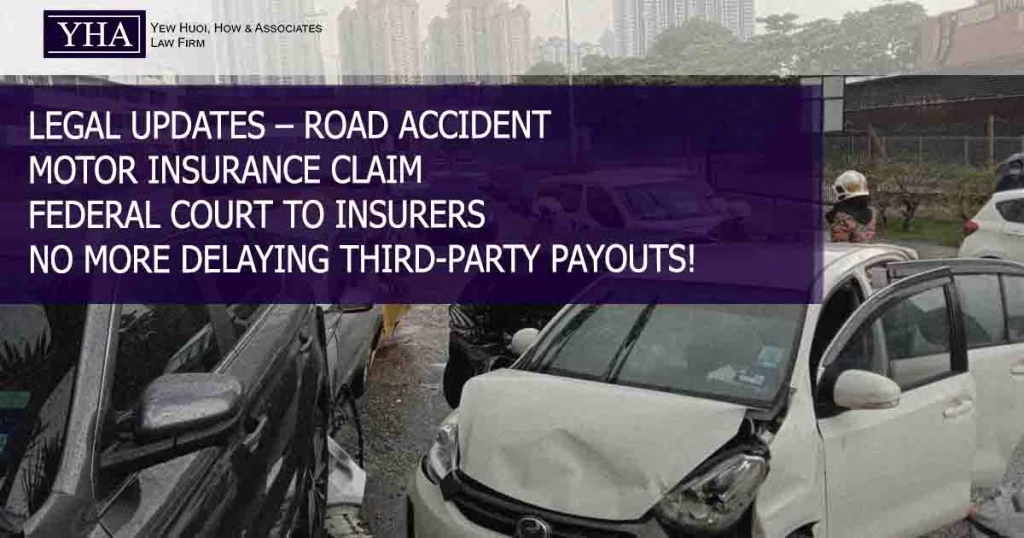
The Federal Court in Chen Boon Kwee v Berjaya Sompo Insurance Bhd [2025] 1 MLJ 158 delivered a crucial ruling that prevents insurers from forcing accident victims to file additional lawsuits to claim their rightful compensation. The court reaffirmed that once a third party has obtained a judgment against the insured, the insurer must pay – no extra legal hurdles, no unnecessary delays. This case marks a significant win for accident victims, ensuring they are not unfairly denied compensation due to procedural roadblocks.
ROAD ACCIDENT – INSURANCE COMPANY STRIKES BACK: HIGH COURT OVERTURNS ROAD ACCIDENT CLAIM

When a motorcyclist claimed he was knocked down in an accident, the Sessions Court ruled in his favor, holding the other rider fully liable. But the insurance company wasn’t convinced. They appealed, arguing that there was no proof of a collision and even raised suspicions of fraud. The High Court took a closer look – and in a dramatic turn, overturned the decision, dismissed the claim, and awarded RM60,000 in costs to the insurer. This case is a stark reminder that in court, assumptions don’t win cases – evidence does.
COMMERCIAL CONTRACT – FORCE MAJEURE OR JUST EXCUSES? LESSONS FROM LITASCO V DER MOND OIL [2024] 2 LLOYD’S REP 593
The recent decision in Litasco SA v Der Mond Oil and Gas Africa SA [2024] 2 Lloyd’s Rep 593 highlights the strict thresholds required to invoke defences such as force majeure and trade sanctions in commercial disputes. The English Commercial Court dismissed claims of misrepresentation and found that banking restrictions and sanctions did not excuse payment obligations under the crude oil contract. This judgment reinforces the importance of precise contractual drafting and credible evidence in defending against payment claims, serving as a cautionary tale for businesses navigating international trade and legal obligations.
ILELGAL MONEYLENDERS – WHEN LOANS CROSS THE LINE: KEY LESSONS FROM SHIM VUI GEH V DAYANG MASTURAH ON ILLEGAL MONEYLENDING AND PROPERTY SECURITY
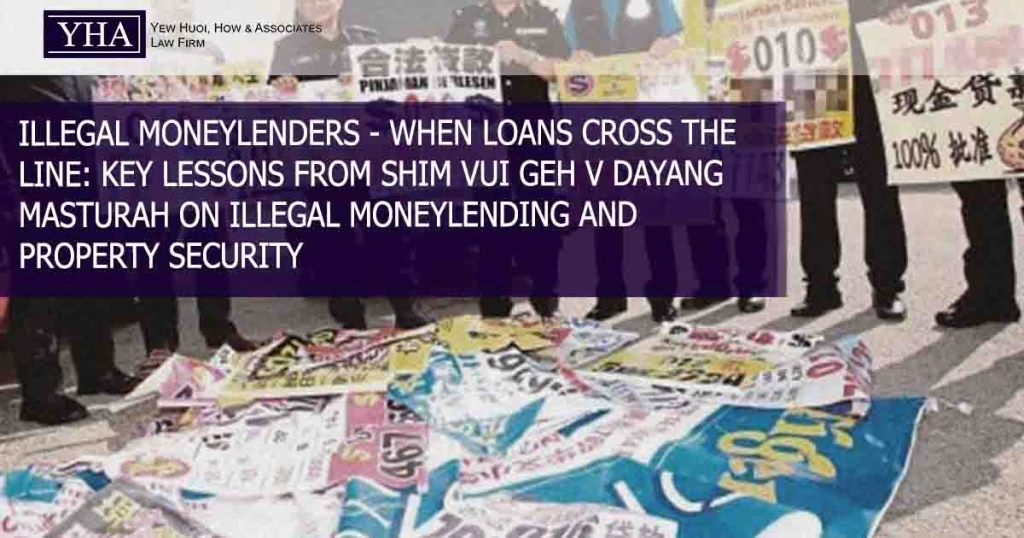
Can a simple loan lead to a legal battle over property ownership? This case reveals how improper security arrangements and high-interest rates can turn financial help into a courtroom showdown, highlighting the critical importance of understanding loan agreements and compliance with the law.
ILLEGALITY OF UNREGISTERED ESTATE AGENTS’ CLAIM – FINDER’S FEES AND ILLEGALITY: COURT DRAWS THE LINE ON UNREGISTERED ESTATE AGENTS

In a pivotal ruling, the Court of Appeal clarified that finder’s fee agreements are not automatically void under the Valuers, Appraisers, Estate Agents and Property Managers Act 1981. The Court emphasized that illegality must be specifically pleaded and supported by evidence, and isolated transactions do not trigger the Act’s prohibition. This decision highlights the importance of precise pleadings and a clear understanding of the law’s scope.
JURISDICTION – CHOOSING THE RIGHT COURT: THE SEA JUSTICE CASE HIGHLIGHTS WHERE MARITIME DISPUTES SHOULD BE HEARD
In The Sea Justice cases [2024] 2 Lloyd’s Rep 383 and [2024] 2 Lloyd’s Rep 429, the Singapore courts tackled a key question: which country should handle a maritime dispute when incidents span international waters? After examining the location of the collision, existing limitation funds in China, and witness availability, the courts concluded that China was the more appropriate forum. This ruling highlights that courts will often defer to the jurisdiction with the closest ties to the incident, ensuring efficient and fair handling of cross-border maritime disputes. This approach is also relevant in Malaysia, where similar principles apply.
BREACH OF CONTRACT – FORCE MAJEURE – FORCE MAJEURE UNPACKED: WHEN ‘REASONABLE ENDEAVOURS’ DON’T BEND CONTRACT TERMS
The UK Supreme Court clarified the limits of force majeure clauses, ruling that “reasonable endeavours” do not require a party to accept alternative performance outside the agreed contract terms. This decision emphasizes that force majeure clauses are meant to uphold, not alter, original obligations – even in unexpected circumstances. The case serves as a reminder for businesses to define alternative options explicitly within their contracts if flexibility is desired.
 MY
MY  EN
EN  ZH
ZH