
PROPERTY LAW – STRATA MANAGEMENT ACT 2013 – REGULATING SHORT-TERM RENTALS: A LEGAL PERSPECTIVE ON STRATA MANAGEMENT AND STATE LAWS
This analysis examines the legal interplay between strata management by-laws and state mandates, particularly focusing on the regulation of short-term rentals within managed communities.
NUISANCE – EVALUATING LEGAL NUISANCE IN GATED COMMUNITIES
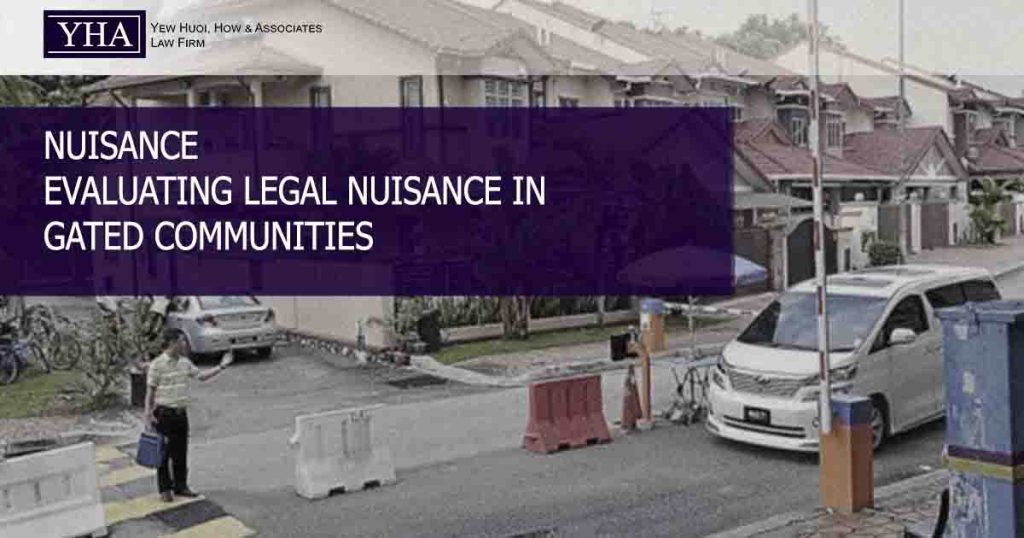
X’s manual operation of boom gates due to unpaid fees does not constitute an actionable nuisance under common law, focusing on community security over individual inconvenience.
CRIMINAL LAW – DANGEROUS DRUGS – JUDICIAL SCRUTINY IN DRUG TRAFFICKING CASES: BALANCING DEFENSE ARGUMENTS AND COMMUNITY SAFETY

This update examines a drug trafficking case involving foreign nationals, highlighting the judicial challenges in balancing defense arguments against statutory presumptions under the Dangerous Drugs Act 1952.
NAVIGATING THE INTERSECTION OF ARBITRATION AND LITIGATION
Explore the delicate balance between court proceedings and arbitration in our latest legal update, focusing on a pivotal case where a request to file a defense leads to a significant legal debate on the appropriate forum for dispute resolution. Gain insights from key cases that define when to push for arbitration over litigation.
FAMILY LAW – DIVORCE – REDEFINING SPOUSAL SUPPORT – FINANCIAL INDEPENDENCE IN DIVORCE PROCEEDINGS

A divorce case involving two insurance agents raises crucial questions about spousal maintenance for financially independent women and their shared responsibility in child support. The court will assess each party’s financial capacity and contributions, considering modern principles of gender equality and the ‘means and needs’ test under the Law Reform (Marriage and Divorce) Act 1976.
JUDICIAL REVIEW – PROCEDURAL FAIRNESS AND LOCUS STANDI
This excerpt illuminates the foundational principles of judicial review as outlined in Order 53 of the Rules of Court 2012. It highlights the criteria for challenging public decisions on grounds of illegality, irrationality, or procedural impropriety. Central to the discussion is the question of timing in judicial review applications, particularly in cases of procedural unfairness. The practical scenario underscores the significance of a “decision” by the relevant authority as a prerequisite for locus standi, drawing insights from the case of Hisham bin Halim v Maya bt Ahmad Fuad & Ors [2023] 12 MLJ 714.
CONTRACT LAW – CONTRACTUAL INTERPRETATION REMEDIES UNVEILED: DECIPHERING CONTRACTUAL CLAUSES AND LEGAL BALANCE
This legal updates explore the principles governing the interpretation of agreements, emphasizing the importance of clarity and unambiguity in contractual terms. It delves into a key issue involving restrictions on remedies for breach of contract, shedding light on the court’s commitment to upholding plain meanings. The illustrative scenario involving shareholders X and Y dissects a pertinent clause, showcasing the delicate balance between restricting remedies and ensuring fairness in legal proceedings.
MANNER TO DELIVER VACANT POSSESSION

Incomplete Utilities in Delivered Property Compensation
TIME’S UP: NAVIGATING THE 12-YEAR LIMITATION

In the intricate dance of land security and loan agreements, the ticking clock of the limitation period cannot be ignored. This excerpt delves into the critical understanding of how the 12-year limitation period, as prescribed by the Limitation Act 1953, plays a pivotal role in the enforcement of property charges in Malaysia. It elucidates the start time of this countdown and its legal implications, providing a comprehensive guide for both lenders and borrowers in navigating these time-sensitive waters.
OVERVIEW OF TORRENS SYSTEMS IN MALAYSIA
Malaysia’s land law and transactions are guided by the Torrens System, which ensures that the land registry accurately reflects all vital details about the land’s registered owner. As per Section 89 of the National Land Code 1965, Malaysia’s land law and transactions are guided by the Torrens System, which ensures that the land registry accurately reflects all vital details about the land’s registered owner. As per Section 89 of the National Land Code.
 MY
MY  EN
EN  ZH
ZH