
Yew Huoi, How & Associates | Leading Malaysia Law Firm

法律资讯

法律资讯

Filter by Category
海事法

WHEN CARGO GOES ASTRAY: THE RISKS OF DELIVERING WITHOUT A BILL OF LADING

In a recent English Court of Appeal decision, the issue of misdelivery without the presentation of the original bill of lading was brought into focus. The court examined the shipowner’s delivery of cargo without presentation of the bill of lading and the subsequent endorsement to UniCredit Bank. Although a breach was found, the claim was dismissed on causation grounds, as the bank had knowledge of and implicitly authorized the delivery. This case emphasizes the crucial role of bill of lading in maritime transactions.

Read More »
疏忽

TORT — NEGLIGENCE — MEDICAL NEGLIGENCE — A MISSED LIFELINE: COURT HOLDS MEDICAL TEAM LIABLE FOR BRAIN DAMAGE IN HIGH-RISK PREGNANCY CASE

A recent High Court ruling involved a plaintiff who suffered severe brain damage after an emergency caesarean section at 33 weeks of pregnancy due to alleged medical negligence. The court examined whether the medical team breached their duty of care by failing to properly monitor the patient, resulting in oxygen deprivation and irreversible damage. The defendants, including doctors and nurses, were found liable for not acting on clear warning signs, leading to significant damages awarded to the plaintiff for her physical and mental disabilities.

Read More »
侵權行為

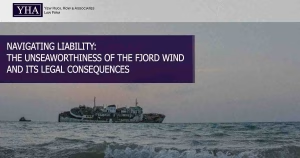
NAVIGATING LIABILITY: THE UNSEAWORTHINESS OF THE FJORD WIND AND ITS LEGAL CONSEQUENCES

The Court of Appeal ruled in The Fjord Wind case that the vessel was unseaworthy at the time of departure from Rosario on 30.06.1990, due to known issues with the crankpin bearings that had not been adequately addressed. This unseaworthiness led to a main engine failure shortly after departure, necessitating the transhipment of cargo and incurring additional costs.

The court found the shipowners liable for damages, emphasizing their failure to exercise due diligence in maintaining the vessel’s seaworthiness. The ruling underscores the critical importance of thorough inspections and repairs in maritime operations, highlighting the legal responsibilities of shipowners to prevent unseaworthiness and related liabilities.

Read More »
物權法

STRATA MANAGEMENT – COMMON PROPERTY CONUNDRUM: CENTRALIZED AC COSTS AND THE STRATA MANAGEMENT DEBATE

In a recent legal dispute, the classification of centralized air conditioning facilities (CACF) as common property has come under scrutiny. The Plaintiff, a parcel owner in Tower A of Menara UOA Bangsar, challenged the Management Body’s use of maintenance funds for the upkeep of CACF, which primarily benefits parcels in Tower B. The court is likely to dismiss the Plaintiff’s claim, reinforcing the principle that as long as CACF serves two or more occupiers, it is deemed common property, thus falling under the Management Body’s purview without requiring reimbursement from individual parcel owners.

Read More »
物權法

RESHAPING HOUSING LAW: THE IMPACT OF ANG MING LEE ON DEVELOPERS AND BUYERS

The landmark Ang Ming Lee decision by the Federal Court invalidated the Minister’s power to grant extensions of time for housing projects, forcing developers to face Liquidated Ascertained Damages (LAD) claims for delays. Subsequent rulings clarified that this decision applies prospectively, ensuring stability in the housing market while reinforcing the need for strict compliance with statutory contracts. This case has significantly reshaped the legal landscape, emphasizing greater accountability for developers and enhanced protections for property buyers.

Read More »

Categories

Recent Legal Updates

STRATA TITLES ACT – DEVELOPER MUST ACCOUNT FOR COMMON PROPERTY COMPENSATION: HIGH COURT IMPOSES CONSTRUCTIVE TRUST

In JMB Kelana Square v Perantara Properties Sdn Bhd & Ors [2025] 12 MLJ 51, the High Court held that a developer who received compensation for land compulsorily acquired for the LRT 3 project could not retain sums attributable to common property. Although the compensation was paid entirely to the developer as registered proprietor, the Court found that part of the acquired land constituted common property, and the developer therefore held RM6.05 million on constructive trust for the Joint Management Body. The decision affirms that JMBs have proprietary standing to recover compensation for common property and that courts will intervene to prevent unjust enrichment in strata developments.

Read More »

UNFAIR DISMISSAL – MEDICAL LEAVE IS NOT MISCONDUCT: HIGH COURT UPHOLDS INDUSTRIAL COURT’S PROTECTION OF SICK EMPLOYEE

In Aerodarat Services Sdn Bhd v Lawerance Raj a/l Arrulsamy & Anor [2025] 11 MLJ 26, the High Court dismissed an employer’s judicial review and affirmed that prolonged medical leave does not, by itself, amount to misconduct justifying dismissal. The Court held that the employer failed to prove the critical element of intention not to return to work or unwillingness to perform contractual duties, despite high absenteeism caused by serious illness and surgery. The ruling reinforces that employers must distinguish between genuine illness and misconduct, and cannot rely on medical absence alone to terminate employment.

Read More »

WILL AND PROBATE – COURT OF APPEAL INVALIDATES WILL OF 97-YEAR-OLD TESTATOR: CAPACITY, SUSPICION AND UNDUE INFLUENCE PROVED

In Kong Kin Lay & Ors v Kong Kin Siong & Ors [2025] 5 MLJ 891, the Court of Appeal set aside a will executed by a 97-year-old testator, holding that there was real doubt as to testamentary capacity, compounded by serious suspicious circumstances and undue influence by certain beneficiaries. The Court emphasised that while the “golden rule” is not a rule of law, failure to obtain medical confirmation of capacity where doubt exists is a grave omission. Credibility issues with the drafting solicitor, beneficiary involvement in the will’s preparation, and suppression of evidence led the Court to declare the will invalid and order intestacy.

Read More »

NOT AN ‘AGREEMENT TO AGREE’: ENGLISH COURT OF APPEAL SAVES LONG-TERM SUPPLY CONTRACT DESPITE OPEN PRICE CLAUSE

In KSY Juice Blends UK Ltd v Citrosuco GmbH [2025] 2 Lloyd’s Rep 581, the UK Court of Appeal held that a long-term supply contract was not unenforceable merely because part of the price was stated as “open price to be fixed”. The Court implied a term that, in the absence of agreement, the price would be a reasonable or market price, noting that the product’s value could be objectively benchmarked against the market price of frozen concentrated orange juice. Emphasising that courts should preserve commercial bargains rather than destroy them, the decision confirms that section 8(2) of the Sale of Goods Act 1979 operates as a saving provision, not a bar to enforceability.

Read More »

DISCOVERY APPLICATION – HIGH COURT ORDERS JPN TO DISCLOSE FAMILY TREE — STATUTORY RIGHT OVERRIDES ADMINISTRATIVE SECRECY

In V Kalanathan a/l Veeran v Ketua Pengarah Jabatan Pendaftaran Negara (JPN) & Ors [2025] 12 MLJ 529, the High Court directed JPN to disclose the family tree details of a deceased co-proprietor to assist in probate proceedings. The Court held that such information, recorded in JPN’s digital registers, constitutes a “document” under Order 24 rule 7A ROC 2012 and is not an official secret in the absence of a valid OSA certification. JPN’s reliance on internal circulars was rejected, as statutory rights under the Births and Deaths Registration Act 1957 cannot be curtailed by administrative policy. The ruling reinforces that discovery against government agencies is permissible where necessary to ensure the fair disposal of proceedings.

Read More »

PROFESSIONAL NEGLIGENCE – SOLICITOR – PANEL SOLICITORS LIABLE: LITIGATION BRIEF DOES NOT EXCUSE FAILURE TO PROTECT BANK’S SECURITY

In Malayan Banking Bhd v Russell Lua Kok Hiyong & Ors [2025] 12 MLJ 599, the High Court held the bank’s former panel solicitors professionally negligent for failing to safeguard the bank’s proprietary interest in a charged property during litigation. The Court ruled that a solicitor’s duty to protect a client’s interests extends beyond the confines of a ‘litigation-only’ brief, particularly where the risk of loss is obvious and foreseeable. Limitation was held to run only when actual loss crystallised, and all partners were found jointly and severally liable under the Partnership Act 1961. The decision is a clear warning that solicitors must act proactively to protect client interests, even outside their immediate scope of instruction.

Read More »

Categories

zh_TWZH
× 联系我们