
Yew Huoi, How & Associates | Leading Malaysia Law Firm

COLLISION COURSE – COURT WEIGHS ANCHOR DRAGGING AND LIABILITY AT SEA

Summary and Facts

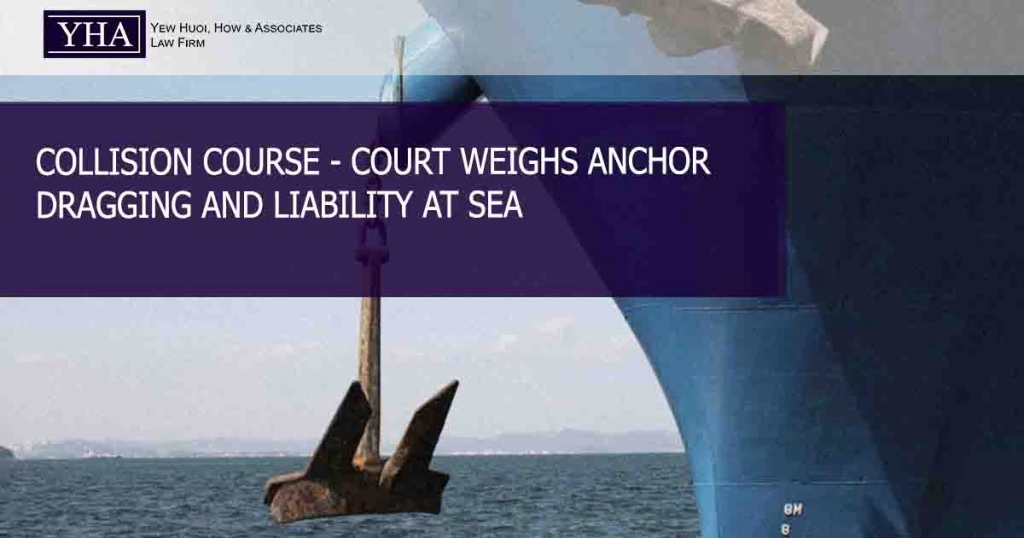
The case The Kiran Australia v Belpareil [2024] 2 Lloyd’s Rep 323 examines a collision between two vessels, the Kiran Australia and Belpareil. The collision resulted from Belpareil’s anchor dragging, which led to a loss of control over its movements and ultimately a collision with Kiran Australia. The court evaluated each party’s liability, apportioning fault based on the actions and omissions of each vessel.

Key Issues

  1. Negligence Due to Dragging Anchor: Was Belpareil negligent because its anchor dragged?
  2. Timely Warnings and Response: Did Belpareil fail to issue timely warnings and respond adequately?
  3. Apportionment of Fault: Should fault be weighted in favor of Kiran Australia despite its limited evasive actions?

Court’s Findings

  • The court found Belpareil primarily at fault for failing to rebut the presumption of negligence associated with dragging anchor. Maritime law often presumes negligence when a vessel’s anchor drags unless unavoidable circumstances can be demonstrated, which Belpareil could not establish.
  • Belpareil also failed to meet its duty to issue prompt warnings to Kiran Australia or to seek tug assistance quickly. These delays substantially contributed to the collision and affected the court’s apportionment of liability.
  • Although Kiran Australia did attempt evasive action, its limited response was hampered by Belpareil’s delays and lack of communication. The court assigned 70% of the fault to Belpareil and 30% to Kiran Australia, placing greater responsibility on the vessel that failed to manage the potential hazard.
  • Kiran Australia was apportioned 30% of the fault because it had a duty to take reasonable evasive action. Despite its attempts to avoid the collision, the court found that these measures were insufficient.

Practical Implications

  • This case highlights the stringent standards of vigilance and communication expected to prevent maritime collisions.
  • Vessel operators should prioritize actively monitoring anchor stability, especially in challenging weather or currents, as failure to do so can result in a presumption of negligence and increased liability.
  • The ruling underscores the need for timely communication with nearby vessels and immediate action, such as engaging tug assistance when needed.
  • Vessel owners must ensure clear protocols for managing anchor dragging and train crews to prioritize swift communication in emergency situations.

Conclusion

This case underscores vessels’ responsibilities in managing anchor dragging risks and highlights the critical role of timely communication to minimize collision risks.

Recent Post

LEGAL UPDATES – THE SILENT CURVE: WHY MEDICAL PREMIUMS SUDDENLY SPIKE

Medical insurance premiums do not increase gradually. They rise exponentially. For many years, costs appear manageable, giving policyholders a false sense of stability. However, once the insured reaches their mid-60s, medical charges begin to accelerate sharply, and after age 70, they often outpace the premiums by several multiples.

This happens because medical insurance is funded from a finite pool of money – an investment “bucket” – while the medical rider functions like an engine that consumes more fuel as the insured ages. When the engine grows faster than the bucket can be replenished, depletion is inevitable. The result is sudden premium hikes, demands for top-ups, or policy lapse – not due to misconduct or missed payments, but due to the structural design of the product itself.

Read More »

THE ‘COVER UNTIL 99’ MYTH – WHY INSURANCE AGENTS GET IT WRONG

Consumers must stop relying on what insurance agents say and start reading what insurance policies actually provide. ‘Medical cover until 99’ does not mean guaranteed coverage at an affordable premium. In reality, medical insurance charges rise exponentially after age 70, often making the policy mathematically unsustainable. By the time policyholders realise this, they are told to top up tens of thousands of ringgit or lose coverage altogether.

Read More »

STRATA TITLES ACT – DEVELOPER MUST ACCOUNT FOR COMMON PROPERTY COMPENSATION: HIGH COURT IMPOSES CONSTRUCTIVE TRUST

In JMB Kelana Square v Perantara Properties Sdn Bhd & Ors [2025] 12 MLJ 51, the High Court held that a developer who received compensation for land compulsorily acquired for the LRT 3 project could not retain sums attributable to common property. Although the compensation was paid entirely to the developer as registered proprietor, the Court found that part of the acquired land constituted common property, and the developer therefore held RM6.05 million on constructive trust for the Joint Management Body. The decision affirms that JMBs have proprietary standing to recover compensation for common property and that courts will intervene to prevent unjust enrichment in strata developments.

Read More »

UNFAIR DISMISSAL – MEDICAL LEAVE IS NOT MISCONDUCT: HIGH COURT UPHOLDS INDUSTRIAL COURT’S PROTECTION OF SICK EMPLOYEE

In Aerodarat Services Sdn Bhd v Lawerance Raj a/l Arrulsamy & Anor [2025] 11 MLJ 26, the High Court dismissed an employer’s judicial review and affirmed that prolonged medical leave does not, by itself, amount to misconduct justifying dismissal. The Court held that the employer failed to prove the critical element of intention not to return to work or unwillingness to perform contractual duties, despite high absenteeism caused by serious illness and surgery. The ruling reinforces that employers must distinguish between genuine illness and misconduct, and cannot rely on medical absence alone to terminate employment.

Read More »

WILL AND PROBATE – COURT OF APPEAL INVALIDATES WILL OF 97-YEAR-OLD TESTATOR: CAPACITY, SUSPICION AND UNDUE INFLUENCE PROVED

In Kong Kin Lay & Ors v Kong Kin Siong & Ors [2025] 5 MLJ 891, the Court of Appeal set aside a will executed by a 97-year-old testator, holding that there was real doubt as to testamentary capacity, compounded by serious suspicious circumstances and undue influence by certain beneficiaries. The Court emphasised that while the “golden rule” is not a rule of law, failure to obtain medical confirmation of capacity where doubt exists is a grave omission. Credibility issues with the drafting solicitor, beneficiary involvement in the will’s preparation, and suppression of evidence led the Court to declare the will invalid and order intestacy.

Read More »

NOT AN ‘AGREEMENT TO AGREE’: ENGLISH COURT OF APPEAL SAVES LONG-TERM SUPPLY CONTRACT DESPITE OPEN PRICE CLAUSE

In KSY Juice Blends UK Ltd v Citrosuco GmbH [2025] 2 Lloyd’s Rep 581, the UK Court of Appeal held that a long-term supply contract was not unenforceable merely because part of the price was stated as “open price to be fixed”. The Court implied a term that, in the absence of agreement, the price would be a reasonable or market price, noting that the product’s value could be objectively benchmarked against the market price of frozen concentrated orange juice. Emphasising that courts should preserve commercial bargains rather than destroy them, the decision confirms that section 8(2) of the Sale of Goods Act 1979 operates as a saving provision, not a bar to enforceability.

Read More »
zh_TWZH
× 联系我们