Yew Huoi, How & Associates | Leading Malaysia Law Firm

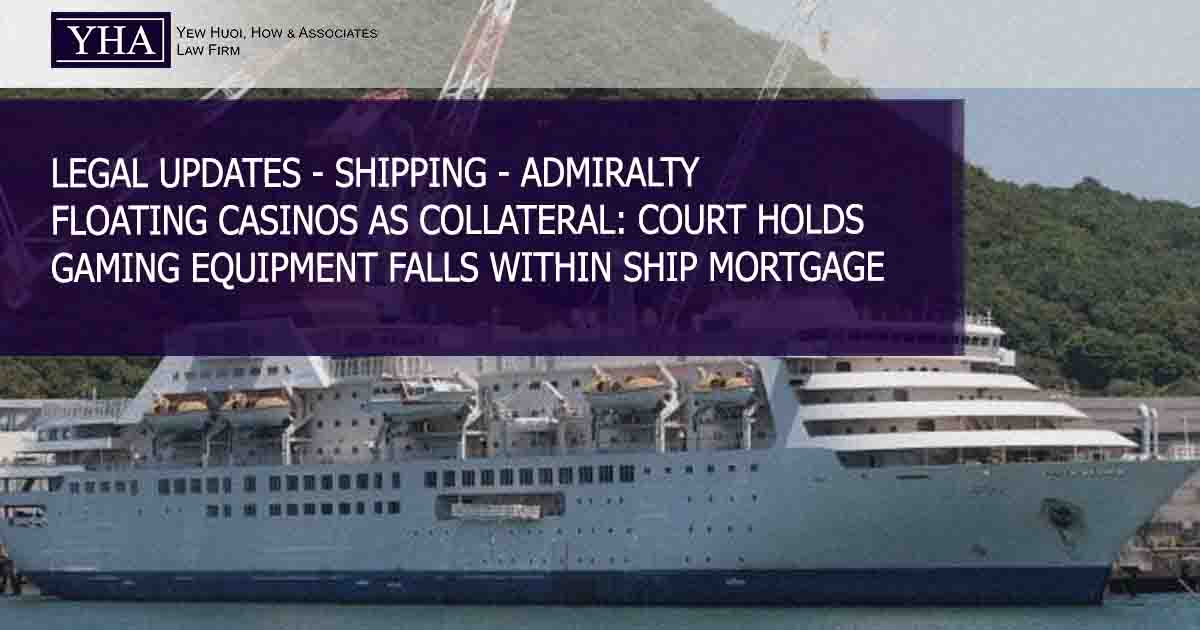
SHIPPING – ADMIRALTY – FLOATING CASINOS AS COLLATERAL: COURT HOLDS GAMING EQUIPMENT FALLS WITHIN SHIP MORTGAGE

1. Summary and Facts

Kfw IPEX-Bank GmbH v Owner of the Vessel “World Dream” [2025] 2 Lloyd’s Rep 137 concerns a dispute over whether the gaming equipment on board the cruise ship World Dream was included in the ship mortgage. The claimant, KfW IPEX-Bank GmbH, a German bank, had financed the construction of the vessel together with other financial institutions. The owner, World Dream Ltd (“WDL”), owned a large cruise ship which had variety of facilities on board such as restaurants, bars, swimming pools, a spa or fitness centre and gaming equipment including slot machines, casino tables and smaller paraphernalia. Later, the parent company entered voluntary winding-up proceedings, triggering an event of default under the facility agreement. This entitled KfW to accelerate the loan. KfW subsequently arrested the vessel in Singapore, obtained judgment, and the ship was sold in 2023 for approximately US$330 million. WDL then applied for a declaration that the on-board gaming equipment did not fall within the scope of the mortgage.

2. Legal Issues

• Whether the mortgage created between WDL and KfW under the Facility Agreement, WD Mortgage and WD Deed included to the gaming equipment on board of the vessel.

3. Court’s Findings

• The Singapore High Court held that “ship” includes articles necessary either for navigation or for the prosecution of the vessel’s commercial adventure. As the World Dream’s adventure was to provide passengers with a multi-faceted leisure and entertainment experience, gaming was integral. The equipment was therefore necessary to the prosecution of that adventure and fell within the mortgage.
• The gaming equipment on board the vessel was included in the mortgage as it was part of the ship.
• The gaming equipment qualified as its appurtenances or integral to its function as a casino cruise ship.

4. Practical Implications

• Mortgage security extends beyond navigation gear to cover high-value commercial equipment necessary for a vessel’s intended adventure (e.g. casinos on cruise ships).
• The decisive factor is whether the item is necessary for the vessel’s adventure, not its physical nature.
• Parties should expressly specify valuable movable assets (e.g. gaming, gym, or luxury equipment) in mortgage deeds to minimise disputes.

Recent Post

EMPLOYMENT – RETRENCHMENT – INDUSTRIAL COURT UPHOLDS GLOBAL RESTRUCTURING: REDUNDANCY VALID DESPITE ONGOING WORK OVERSEAS

In Sin Leong v BT Systems (M) Sdn Bhd [2025] 4 ILJ 221, the Industrial Court upheld the employer’s retrenchment exercise following a global restructuring, ruling that the claimant was lawfully dismissed due to genuine redundancy. Although the claimant’s functions continued in India, the Court held that the abolition of the entire Malaysian team sufficed to establish redundancy. The company’s profitability did not negate the restructuring, and the LIFO principle did not apply since the whole department was closed. The decision reinforces that courts will respect managerial prerogative, provided the retrenchment is bona fide and not tainted by mala fide or victimisation.

Read More »

DECREE NISI – ADULTERY AND FRAUD – NOT CONCEAL REMARRIAGE – COLLUSION EVIDENCE

In Kanagasingam a/l Kandiah v Shireen a/p Chelliah Thiruchelvam & Anor [2026] 7 MLJ 494, the High Court set aside spousal maintenance and committal orders after finding that the ex-wife had fraudulently concealed her remarriage, which by law extinguished her entitlement under section 82 of the Law Reform (Marriage and Divorce) Act 1976. The Court held that consent orders obtained through non-disclosure were vitiated by fraud and ordered repayment of RM310,000, together with RM400,000 in aggravated damages and RM300,000 in exemplary damages. The decision underscores that fraud unravels all, even in family proceedings, and that courts will not hesitate to impose punitive consequences for abuse of process.

Read More »

FEDERAL COURT SAVES SECTION 233 CMA: ‘OFFENSIVE’ AND ‘ANNOY’ REMAIN CONSTITUTIONAL

In The Government of Malaysia v Heidy Quah Gaik Li [2026] MLJU 384, the Federal Court overturned the Court of Appeal’s ruling that had struck out the words “offensive” and “annoy” from section 233(1)(a) of the Communications and Multimedia Act 1998. The Court held that these terms, when read together with the requirement of intent to annoy, fall within the permissible restrictions on free speech under Article 10(2)(a) of the Federal Constitution. While the impugned words were upheld as constitutional, the respondent’s acquittal was maintained as her Facebook posts criticising immigration detention conditions did not demonstrate the required intent to annoy or harass.

Read More »

HIGH COURT ORDERS TIKTOK VIDEO TAKEN DOWN: ADVICE ON SECRET CONVERSION OF MINORS VIOLATES CONSTITUTION

In Karnan a/l Rajanthiran & Ors v Firdaus Wong Wai Hung [2025] 9 MLJ 14, the High Court granted a mandatory interim injunction ordering the immediate removal of a viral TikTok video advising how underaged non-Muslim children could be secretly converted to Islam without their parents’ knowledge. The Court held that the advice prima facie breached Article 12(4) of the Federal Constitution, which provides that a minor’s religion must be determined by their parent or guardian. Given the risk of irreparable harm to constitutional rights, the Court found the case “unusually strong and clear” and concluded that justice and the balance of convenience favoured the urgent removal of the video pending trial.

Read More »

MARITIME LAW – CLAUSES 28 AND 29 BARECON 2001 – OWNERS CAN’T PICK ANY PORT: COURT LIMITS ‘CONVENIENCE’ IN VESSEL REPOSSESSION CLAUSE

In Songa Product and Chemical Tankers III AS v Kairos Shipping II LLC [2026] 1 Lloyd’s Rep 100, the Court of Appeal held that a clause allowing owners to repossess a vessel at a location “convenient to them” does not entitle them to demand redelivery at any distant port of their choosing. The Court emphasised that repossession must occur as soon as reasonably practicable, and where the vessel is already at a safe and accessible port, owners cannot require charterers to incur the cost and risk of sailing it across the world. The decision clarifies that charterers, as gratuitous bailees post-termination, are only obliged to preserve the vessel – not to undertake burdensome repositioning for the owners’ convenience.

Read More »

MARINE INSURANCE – FRAUD DOESN’T DEFEAT COVER: COURT UPHOLDS MORTGAGEE’S CLAIM UNDER MII POLICY OF MORTGAGEE’S CLAIM

In Oceanus Capital Sarl v Lloyd’s Insurance Co SA (The “Vyssos”) [2026] 1 Lloyd’s Rep 79, the Commercial Court held that a mortgagee was entitled to recover under a Mortgagee’s Interest Insurance (MII) policy despite a forged war risks cover note and a breach of trading warranties by the shipowner. The Court found that the proximate cause of loss was the mine strike, not the forged insurance, and that the mortgagee was not “privy” to the breach, as its consent had been induced by fraud. The decision reinforces that MII policies are designed to protect lenders from owner misconduct and non-recovery under primary insurance, and that fraud will not defeat cover where the mortgagee acted reasonably.

Read More »
zh_TWZH