
ADMIRALTY – LIMITATION OF LIABILITY – REPAIRS VS CARGO REMOVAL: SUPREME COURT DRAWS THE LINE ON LIMITATION1976, ARTICLE 2
In MSC Mediterranean Shipping Co SA v Conti 11 Container Schiffahrts-GmbH & Co KG (The “MSC Flaminia”) [2025] 2 Lloyd’s Rep 150, the UK Supreme Court clarified the scope of the 1976 Limitation Convention. The Court held that charterers may limit liability for claims brought directly by owners, rejecting the Court of Appeal’s restrictive “owner’s original loss” rule. However, it reaffirmed that claims for loss of or damage to the vessel itself and consequential losses remain non-limitable. Importantly, the Court drew a distinction between repair costs (not limitable) and cargo-related costs (potentially limitable): while payments to authorities, removal of fire-fighting water, and waste disposal were treated as repair costs, the discharging and decontamination of cargo fell within Article 2.1(e) as limitable claims. The ruling underscores the need for careful characterisation of claims when invoking limitation rights.
MARITIME LAW – LIEN, LOSS AND LMAA: ENGLISH COMMERCIAL COURT ORDERS SALE OF DETERIORATING CARGO
In Lord Marine Co Ltd v Vimeksim Trans SA & Anor [2025] 2 Lloyd’s Rep 52, the English Commercial Court exercised its powers under s.44 Arbitration Act 1996 to order the sale of a deteriorating cargo of Ukrainian corn over which the shipowners had exercised a lien for unpaid freight. Mr Justice Bryan held that the cargo was the “subject of the proceedings” and that the court could intervene to preserve its value pending LMAA arbitration. The decision clarifies that a “freight prepaid” stamp does not estop owners where freight has not actually been paid and the bills of lading never left owners’ possession, and that possession can be maintained even when the cargo is stored in a receivers’ warehouse. This case reinforces the court’s readiness to act swiftly to prevent the loss of value in perishable cargo while safeguarding parties through fortified undertakings in damages.
ARBITRATION – SHIPPING – REPAIR GONE WRONG: CLARIFYING SHIPYARD LIABILITY IN ARBITRATION (“MARE NOVA”)
In Hai v Pai & Anor [2025] 8 MLJ 211, the Court decisively addressed the delicate intersection of marital betrayal and financial fairness. Affirming the award of damages against a third-party “homewrecker,” the decision underscores the judiciary’s firm stance on compensating emotional and financial harm arising from adultery. Furthermore, the ruling clarifies the importance of precise documentation and the consequences of commingling inherited wealth, reinforcing that matrimonial asset division requires careful, individualized assessment to achieve true equity.
SHIPPING – ADMIRALTY IN REM – ANCHORED BUT NOT ADRIFT: REDEFINING “SHIP” IN ADMIRALTY JURISDICTION
The Singapore High Court in Vallianz Shipbuilding & Engineering v Owner of the Vessel ‘Eco Spark’ [2025] 1 Lloyd’s Rep 195 clarified the definition of a ‘ship’ under admiralty jurisdiction. Despite conversion into a stationary floating fish farm, the vessel retained its status as a ship due to its inherent navigational capability, significantly broadening the scope of admiralty law.
NAVIGATION AND SHIPPING LAW – COLLISION REGULATIONS – COLLISION AT SEA – A WAKE-UP CALL FOR ADHERING TO NAVIGATION RULES
The collision between the FMG Sydney and MSC Apollo highlights the critical importance of adhering to established navigation rules. Deviations, delayed actions, and reliance on radio communications instead of clear, early maneuvers can lead to disastrous outcomes. This case serves as a stark reminder for mariners: follow the rules, act decisively, and prioritize safety above assumptions.
SHIPPING AND ADMIRALTY IN REM – A SINKING ASSET – COURT ORDERS SALE OF ARRESTED VESSEL TO PRESERVE CLAIM SECURITY
In a landmark admiralty decision, the High Court ordered the pendente lite sale of the arrested vessel Shi Pu 1, emphasizing the principle of preserving claim security over the defendant’s financial incapacity. The court ruled that the vessel, deemed a “wasting asset,” could not remain under arrest indefinitely without proper maintenance or security. This case reinforces the necessity for shipowners to manage arrested assets proactively to prevent significant financial and legal repercussions.
CHARTERPARTY AGREEMENTS – CHARTERER’S GUIDE TO FOULING CLAUSES
In maritime charterparty agreements, fouling clauses outline who is responsible for the costs and time associated with hull cleaning when marine organisms accumulate due to specific operating conditions. These clauses are crucial for clarifying liabilities, particularly when charterers operate in warm, bio-rich waters or leave vessels idle, as fouling can significantly impact performance and fuel efficiency. Understanding the scope of a fouling clause helps charterers navigate potential costs and ensure clear terms for post-redelivery responsibilities, as highlighted in cases like The “Globe Danae” [2024] 1 Lloyd’s Rep. 309.
ADMIRALTY IN REM – SHIPPING — FUEL OR FREIGHT? COURT CLEARS THE AIR ON GLOBAL FALCON BUNKER DISPUTE
In a decisive ruling on the Global Falcon bunker dispute, the court dismissed Meck Petroleum’s admiralty claim for unpaid high-sulphur fuel, finding that the fuel was supplied not for operational purposes but as cargo. With the vessel lacking necessary equipment to use high-sulphur fuel and evidence pointing to its transfer to another vessel, the court determined that Meck’s claim fell outside admiralty jurisdiction, leading to the release of the vessel and potential damages for wrongful arrest.
COLLISION COURSE – COURT WEIGHS ANCHOR DRAGGING AND LIABILITY AT SEA
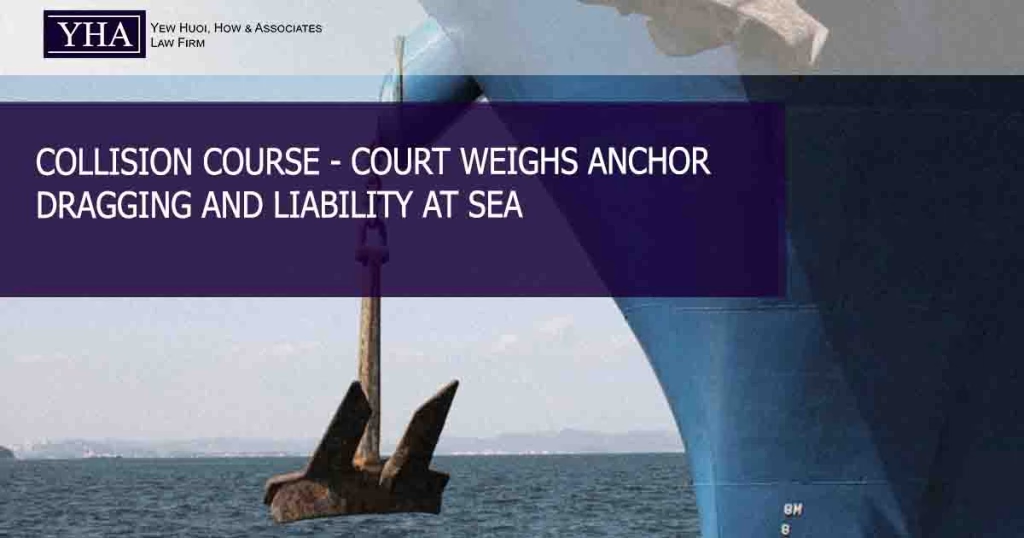
In a collision that underscores the high stakes of maritime vigilance, the court ruled that Belpareil bore the brunt of the blame for failing to control its dragging anchor and delaying critical warnings. Yet, Kiran Australia wasn’t off the hook entirely—apportioned 30% fault for its limited evasive action, the case serves as a stark reminder: in maritime law, all vessels share responsibility in averting disaster, even when one party’s errors loom large.
GENERAL AVERAGE – PIRATE RANSOM DISPUTE: SUPREME COURT RULES CARGO OWNERS LIABLE IN THE POLAR CASE
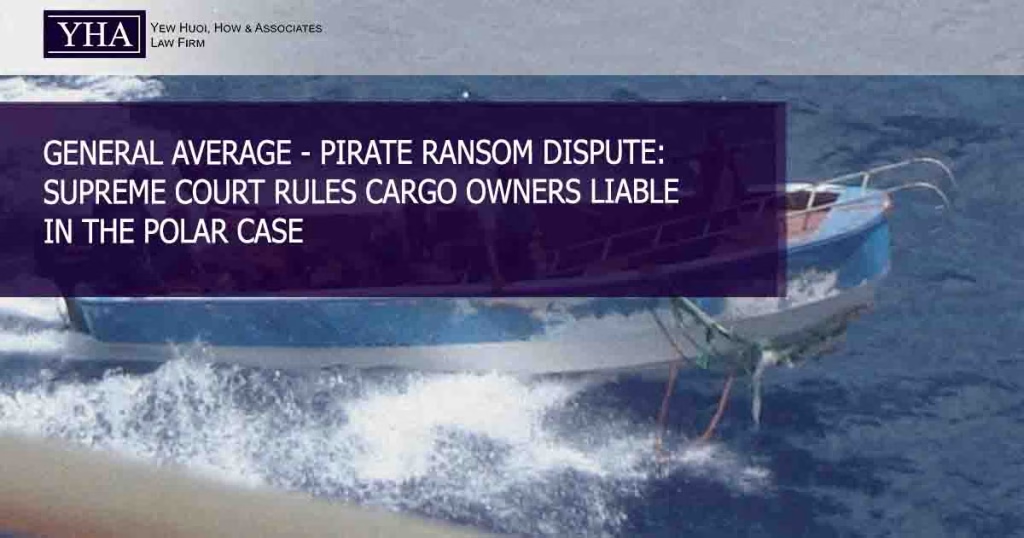
In the landmark case Herculito Maritime Ltd v Gunvor International BV (The Polar) [2024] 1 Lloyd’s Rep. 85, the English Supreme Court upheld the shipowner’s right to recover a USD 7.7 million ransom paid to Somali pirates under general average. The Court ruled that cargo interests, despite their arguments regarding charterparty terms and insurance obligations, were liable to contribute to the ransom payment. This decision reinforces the importance of clear contractual provisions when seeking to limit or exclude liability in maritime contracts particularly matter relating to general average.
 EN
EN  ZH
ZH  MY
MY